
Agile MBA

What is the Agile MBA™?

The Agile MBA is here to provide upskilling in Agile and Scrum and prepare you to successfully navigate the complex, knowledge-based world. 

Take the Agile MBA and you’ll join a community of Job Hackers around the world. Leverage the knowledge you gain to obtain Scrum certifications such as the Professional Scrum Master I, use your experience as credit towards PDUs and SEUs, and take advantage of valuable networking opportunities and career assistance.

Our class material is based on years of real-world Agile and Scrum experience across multiple industries. If you join during our free early enrollment window or choose a later enrollment period, either way the course content is the same for everyone. 

Want to learn more? Feel free to check out our reviews on SwitchUp! We have a 4.98/5 rating with more than 140 reviews.

When is the Next Course?

The Agile MBA runs for six weeks four times a year – once each quarter.

Our Q4 course runs from October 13th – November 19th. Enrollment is now open until October 12th. Free enrollment is available through a Scholarship Application until September 25th. 

Classes in each course are held every Tuesday and Thursday from 7:30am-9:00am Pacific (GMT-7 PDT) online anywhere in the world via Zoom. For those who enroll, sessions are recorded in case you miss a class and provided through the Slack community workspace we provide to Agile MBA participants.

When is the Next Course?

The Agile MBA runs for six weeks four times a year – once each quarter.

Our Q3 course runs from July 21st – August 29th and Enrollment is now open! Fill out the form below and we will email you with details on how to enroll and take the course entirely for free. Take advantage of Free Open Enrollment through July 4th (Pacific Time)!

Classes in each course are held every Tuesday and Thursday from 7:30am-9:00am Pacific  (GMT-7 PDT) online anywhere in the world via Zoom. For those who enroll, sessions are recorded in case you miss a class and provided through the Slack community workspace we provide to Agile MBA participants.

What Topics Are Covered?

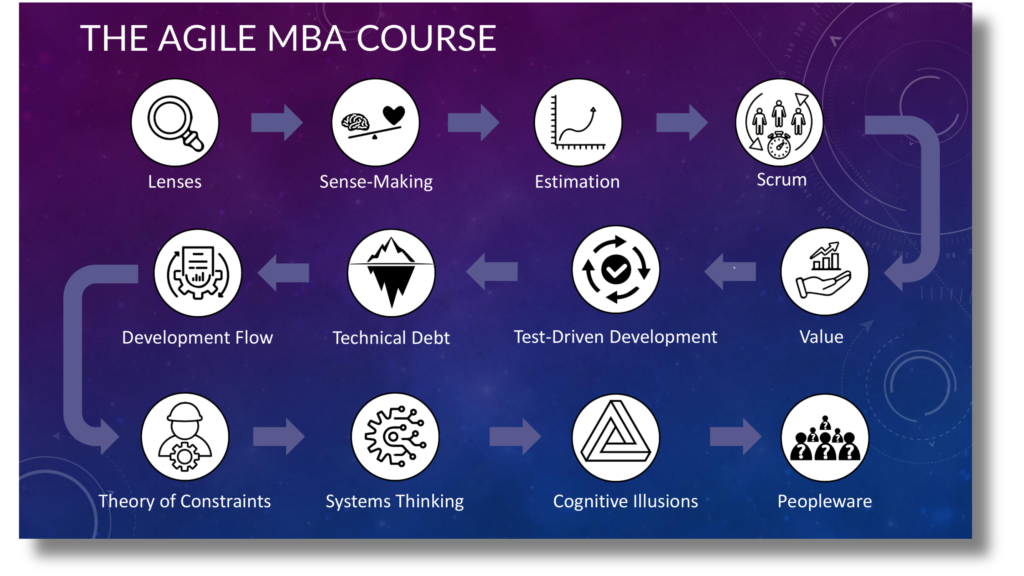
Twelve live sessions over six weeks. Each one builds on the last: first understanding problems, then teamwork, value and flow, and finally the people who make it all work, including how to put what you’ve learned to use with AI.

Visual map of course format

Week 1

  • Introduction to Agile
  • Understanding Problem Types
  • Relative Estimation

Week 2

  • Scrum – The What and Why
  • Scrum – The How

Week 3

  • Test-Driven Development & Behavior-Driven Development
  • Technical Debt

Week 1: Understanding Problems

Foundations of Agile
Why do some teams adapt quickly while others stall? Find out where Agile came from, what it means beyond the buzzword, and why it treats plans as ideas to test rather than promises. Using simple tools like the scientific method and Cynefin, you’ll learn to judge how uncertain your work is and choose an approach that fits.

Agile Terminology, Uncertainty and Relative Estimation
Every team gets asked “how big?” and “when?” Start with the Agile Manifesto, then learn how teams answer those questions honestly when they don’t have all the facts. You’ll size work together in a hands-on exercise, use value and effort to decide what to do first, and forecast delivery as a realistic range rather than a promise you can’t keep.

Week 3: Value and Quality

Value Part 1: Value, Backlogs, Requirements and User Stories
Being busy isn’t the same as delivering value, and code on its own isn’t value either. Learn the difference between outputs and outcomes, why requirements are so hard to get right, and how to test an idea with real users before you commit. That includes quick prototypes built with AI tools such as Claude Code, Cursor, Lovable and Figma Make.

Value Part 2: Behavior Driven Development, Trade-offs and Technical Debt
A new CTO wants more features out of every Sprint. Is that the right goal? Learn how Test-Driven and Behavior-Driven Development help you build the thing right and build the right thing. You’ll write user stories with clear acceptance criteria, use the 80/20 rule to find the work that matters most, and see why technical debt, like any debt, charges interest.

Week 5: Constraints and Systems

Principles of Product Development Flow Part 3 and Theory of Constraints
What do you do first when everything seems urgent? Learn to sequence work using Cost of Delay and job size, why fast feedback beats long plans, and how to move decisions to the people who have the information. Then use Goldratt’s Theory of Constraints to find the bottleneck holding your system back, with lessons from the WWII Liberty Ships.

Introduction to Systems Thinking
Most problems come from the system, not the people in it. Learn how feedback loops and hidden incentives shape results, and why well-meant fixes backfire (the “Cobra Effect”), right up to a recent AI leaderboard that staff gamed with pointless prompts. Drawing on Senge, Deming and Ackoff, you’ll learn to step back and see how the parts fit before you act.

Week 4

  • Product Development Flow
  • Queues, Batch Sizes, and Work in Progress
  • Why Proper Sequencing is Crucial

Week 5

  • Systems Thinking
  • Theory of Constraints
  • The Cobra Effect
  • Holistic (Throughput) Accounting

Week 6

  • Human Factors
  • Cognitive Illusions and Biases
  • Motivations
  • Psychological Safety
  • Peopleware

Week 2: Agile Teamwork

Scrum Part 1: The What and Why
Scrum has become the most popular Agile approach, and when most people say “Agile”, this is usually what they mean. Discover its roots in Lean thinking, the roles, events and artifacts that make it work, and why it tends to beat traditional project management on complex problems. It’s a solid foundation if you’re preparing for the Professional Scrum Master I certification.

Scrum Part 2: The How
Learn the principles that make Scrum work day to day: self-organization, cross-functional teams, decisions based on evidence, a sustainable pace and continuous improvement. You’ll practice refining a user story by asking the questions a team needs answered, and see how the Definition of Done and the right team size keep quality high and work moving.

Week 4: Optimizing Flow

Principles of Product Development Flow Part 1
Why do the busiest teams often deliver the slowest? Drawing on Don Reinertsen’s work, learn to take an economic view of your work, put a price on waiting with Cost of Delay, and spot the hidden queues that build up when everyone runs at full capacity. You’ll also see why some variability is worth keeping, because that’s where innovation comes from.

Principles of Product Development Flow Part 2
Why does starting more work often mean finishing less? Learn how smaller batches and limits on work in progress (WIP) shorten cycle times and speed up feedback. Cut WIP in half and you can roughly halve the time it takes to finish. You’ll also see how Kanban makes work visible, and how it compares with Scrum.

Week 6: People

Cognitive Biases and Illusions
Your brain takes shortcuts, and they can lead smart people into poor decisions. Through eye-opening illusions and real stories, from the history of hand-washing to a tragedy on Everest, learn to recognize biases like confirmation bias and sunk cost. You’ll leave with practical ways to slow down and decide better.

Peopleware
The biggest problems in knowledge work are rarely technical. They’re about people. Explore what really motivates knowledge workers, what good leadership and followership look like, and how the Ladder of Inference stops you jumping to conclusions. Then bring the whole course together, using what you’ve learned about systems, flow and constraints to help people adopt AI in ways that create real value.

FAQs

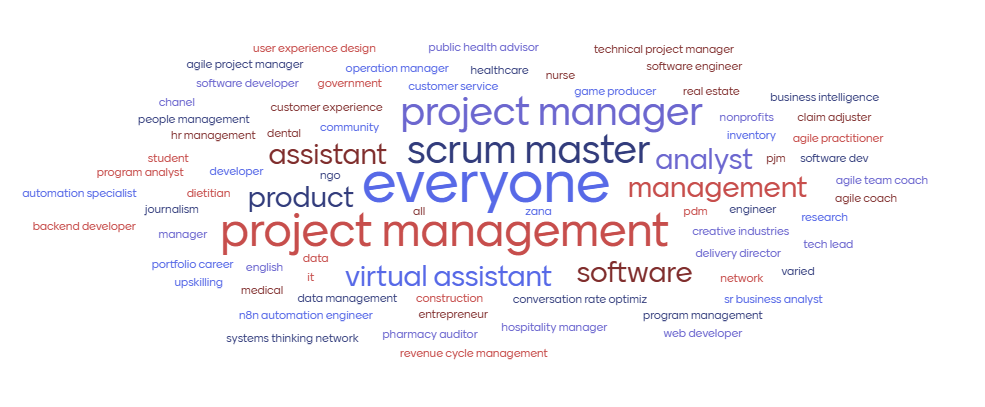
There are no prerequisites to enroll in the Agile MBA™. No need to know programming or have a background in tech. The course is open to anyone worldwide at any stage of their career. The average age of our students is 34 and here’s an example of our most recent cohort:
Enrollment is opened up a few weeks before the start of each course. In order to receive the link to the enrollment form, you should first fill out the participant sign up form further down on this page. If you have previously filled out the form for another quarter’s course, and you are interested in the current course, please fill out the form again.

We have a phased approach for enrollment that allows participants to join early and still support the long-term sustainability of the program.

For the Q3 Agile MBA the enrollment phases were:

  • June 26 – July 4 (⌛Ends @ 11:59PM PDT): Free Open Enrollment – $ FREE!
  • July 5 – July 17 (⌛Ends @ 11:59PM PDT): Early Bird contribution pricing –  $18  
  • After July 17: Standard contribution pricing – $60
  • July 20 (@ 10:00 PM PDT): Enrollment closes – class starts July 21 (optional Orientation on July 20)

Participants who attend at least six sessions will qualify for a Certificate of Attendance, to be provided with the contribution of a $20 service fee.

All classes are recorded in case you have to miss a class in the course and will be provided in our Slack workspace for the length of the course. Please note that you will only receive a Certificate of Attendance if you attend at least six out of the 12 classes live on Zoom.

Yes! Attending the Agile MBA live qualifies you for up to 27 PDUs and SEUs applicable toward certifications including PMP, PMI-ACP, CSM, PSM and others through PMI and Scrum Alliance.

Tuesday and Thursday live sessions count as Education hours. Our Friday Discussion sessions are also eligible. Fridays cover additional course content, certification prep and case study discussions.

Contact Us

Follow us on Social Media

Support the Job Hackers

Our mission is to provide affordable global access to education and experiences that develop the skills and mindset needed to navigate the professional world of knowledge work. 

Subscribe to our Newsletter